Hee-joo
The VegetarianHee-joo is a patient receiving treatment for alcoholism and hypomania at the psychiatric hospital where Yeong-hye is hospitalized. She becomes one of Yeong-hye’s carers when Yeong-hye grows difficult to manage and refuses food. Though her role is practical, Hee-joo is not a neutral attendant: her concern, physical care, and grief make her a significant figure in the hospital scenes, where care and confinement exist side by side.
Identity and Role
Hee-joo is a stout, middle-aged woman with round eyes and a voice described as somewhat hoarse. The hospital’s more self-controlled patients look after those with more acute psychological difficulties in exchange for a small amount of pocket money. When Yeong-hye becomes harder to care for, Hee-joo is put in charge of her. The arrangement places Hee-joo in a position between patient and caregiver: she is receiving treatment herself, yet takes on sustained responsibility for another patient’s daily needs.
Caring for Yeong-hye
Hee-joo tells In-hye that Yeong-hye has vomited blood and is suffering convulsions after not eating. She worries aloud that Yeong-hye might die, and wonders whether she could have prevented the deterioration by caring for her better. Her distress is not presented as professional detachment; she speaks as someone who has become personally invested in the patient entrusted to her.
That investment is visible in the ordinary work of care. Hee-joo washes Yeong-hye with a wet towel and powders her skin, while the damp weather makes it difficult for the skin to heal. She explains that bathing Yeong-hye once required help from a nurse, but Yeong-hye has become so light that Hee-joo can lift her alone. She describes the work as being like caring for a baby, and hopes to bathe Yeong-hye one last time before the transfer to another hospital. When In-hye agrees to help, Hee-joo says the hot water will be available at four. The details make care a matter of repeated, intimate labor rather than a general expression of sympathy.
Relationship with In-hye
Hee-joo’s contact with In-hye is brief but emotionally open. When In-hye thanks her, Hee-joo clasps her hand, and later her eyes fill with tears as she reports how ill Yeong-hye has become. The two women share concern for Yeong-hye, but their positions are different: In-hye is her sister and bears responsibility for her care, while Hee-joo has been assigned to the daily work of looking after her within the ward. Their exchange gives In-hye a witness to Yeong-hye’s decline and to the burden of caregiving inside the hospital.
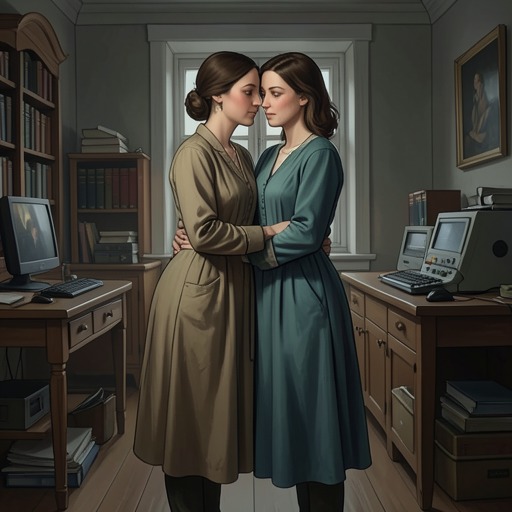
After Yeong-hye undergoes an unsuccessful attempt at feeding through a tube, In-hye leaves the treatment room in distress and encounters Hee-joo in the corridor. Hee-joo asks after Yeong-hye and offers to accompany In-hye, but In-hye takes her hand and thanks her instead. She feels an impulse to embrace Hee-joo, yet does not act on it. Her hesitation is bound up with guilt about Yeong-hye’s confinement, a guilt that makes closeness difficult even when care is shared.
Confinement and Significance
The hospital’s patients gather at a window when sunlight enters the lobby, appearing captivated by the possibility of being outside. In-hye thinks of them as trapped, and recognizes Hee-joo as one of those confined there, alongside Yeong-hye. The scene broadens Hee-joo’s significance beyond her role as caregiver: she is also a patient whose own freedom is limited, even as she helps care for someone more acutely ill.
When two carers later bring Yeong-hye out on a stretcher, Hee-joo reaches for her wasted hand. In-hye turns away rather than watch. Hee-joo’s gesture is small and direct, a continuation of the care she has provided; it also stands in contrast to the clinical procedures that have just taken place. Her story remains limited to the hospital and its routines, but within those limits she gives the novel a distinct image of caregiving: vulnerable, laborious, and emotionally consequential, carried out by someone who is herself a patient.